Harper Günther · 30 September 2026
Analyzing Long-Term User Retention Patterns in Evolving Digital Ecosystems
Digital ecosystems continue to shift through algorithm updates, new feature rollouts, and changing user behaviors, yet retention patterns reveal consistent structures that researchers track across platforms. Data from multiple industry reports shows that users who engage within the first seven days after onboarding demonstrate higher survival rates in subsequent months, while those who skip early interactions tend to drop off sharply by week four. Observers note that these patterns hold across social networks, productivity tools, and entertainment services even as interfaces evolve.
Core Metrics Used in Retention Analysis
Analysts rely on cohort-based measurements to map how groups of users acquired in the same period behave over extended timelines, and they combine daily active user figures with monthly active user ratios to gauge stickiness. Research indicates that a retention curve often stabilizes after the initial thirty days, though the exact percentage retained varies by sector and platform maturity. Those who've examined large datasets point out that lifetime value calculations become more accurate when paired with churn velocity data collected at regular intervals.
Platforms collect behavioral signals such as session frequency, feature adoption depth, and content interaction volume, then feed these into predictive models that flag at-risk users before they leave. Studies found that integrating these signals with demographic information improves forecast precision, particularly when ecosystems undergo major redesigns or policy shifts.
Factors Shaping Retention Across Changing Environments
Algorithm adjustments that alter content visibility frequently trigger measurable drops in return visits, yet users who have formed habitual loops around notifications or community features show greater resilience. External events including device operating system updates or regulatory changes in data handling can also interrupt established patterns, and analysts track these disruptions by comparing pre- and post-event cohorts. Evidence suggests that seamless migration of user preferences during such transitions helps maintain continuity, while abrupt feature removals accelerate attrition.
Network effects play a documented role in mature ecosystems, where the presence of existing connections raises the barrier to departure. Researchers discovered that platforms emphasizing these connections through group features or shared progress systems record slower decay rates in long-term curves. At the same time, competition from emerging services can siphon users whose primary motivation was novelty rather than sustained utility.
Observed Patterns in Different Digital Sectors
Mobile applications focused on utility demonstrate stronger month-three retention when users complete core setup tasks early, whereas entertainment apps depend more heavily on content freshness and personalization accuracy. SaaS products that evolve their core workflows gradually rather than through disruptive overhauls tend to preserve enterprise cohorts at higher rates, according to aggregated platform telemetry. Social platforms exhibit distinct seasonal fluctuations tied to real-world events, and these spikes can temporarily mask underlying downward trends if not isolated in the analysis.
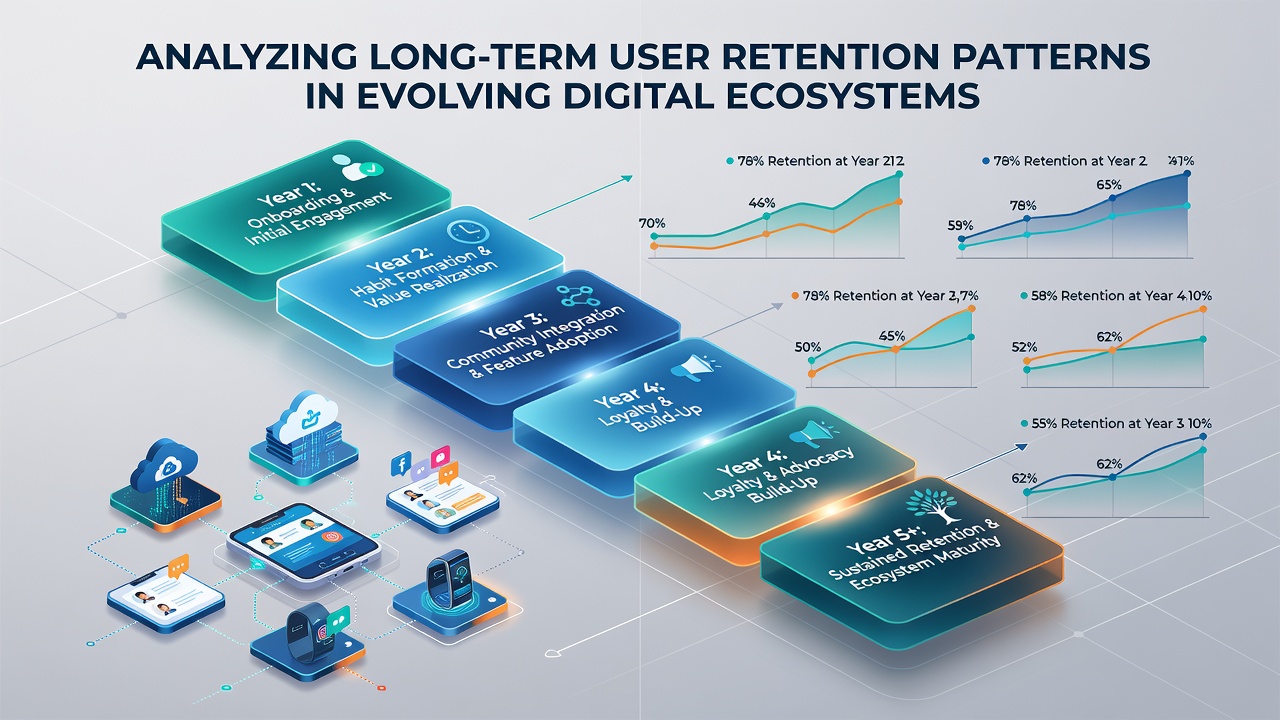
One study revealed that users acquired through referral programs in gaming ecosystems maintain longer engagement windows compared with those acquired via paid advertising, though the gap narrows once both groups reach the six-month mark. Observers note similar dynamics in productivity suites where collaborative features create compounding value over time. Data shows that cross-platform continuity, such as synchronized progress across mobile and desktop clients, correlates with elevated long-term retention figures in multiple categories.
Developments Captured Through Mid-2026 Reporting
In September 2026, several large-scale telemetry reviews highlighted how privacy-focused changes implemented earlier that year influenced retention trajectories differently across regions. European platforms recorded steadier cohort survival after implementing granular consent flows, while North American services saw initial friction followed by recovery once users adapted to new defaults. Pew Research Center analysis of digital engagement trends provided additional context on these regional variations. Australian digital economy statistics released around the same period indicated that smaller platforms with transparent data practices experienced less pronounced churn during the transition period.
Advanced modeling techniques incorporating machine learning now allow teams to simulate the impact of proposed ecosystem changes before deployment, and early adopters of these methods report improved ability to preserve high-value user segments. Yet the models require continuous retraining as user expectations shift alongside technological capabilities.
Conclusion
Long-term retention analysis in evolving digital ecosystems rests on systematic measurement of cohort behavior combined with awareness of external and internal variables that reshape engagement. Patterns documented across sectors show that early habit formation, feature stability, and network reinforcement contribute to sustained participation even amid platform evolution. Reports from September 2026 and earlier periods demonstrate that proactive adaptation to regulatory and technological shifts can mitigate attrition when implemented with attention to existing user workflows. Continued refinement of analytical tools supports more accurate forecasting as ecosystems grow more interconnected.